Introduction
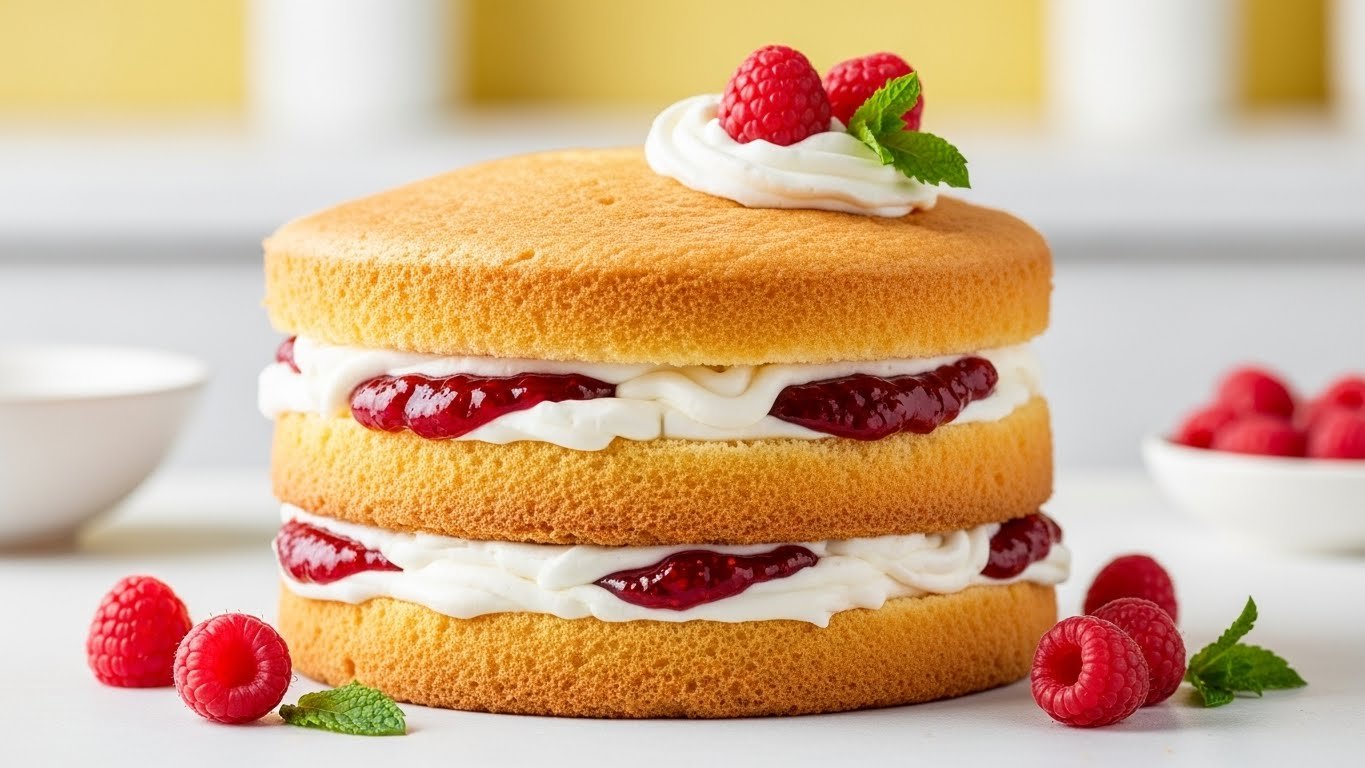
A fluffy British Victoria sponge cake is one of those simple, beautiful bakes that always feels special. Two light, golden sponge layers, sandwiched together with sweet jam and soft clouds of cream, then finished with a light dusting of sugar… it’s classic, elegant, and incredibly satisfying.
This cake is a true British favourite. It’s not overloaded with frosting or decorations. Instead, it focuses on what really matters: perfectly soft sponge, good jam, and fresh cream.
The best part? A Victoria sponge cake is much easier to make than it looks. Once you understand a few simple rules – equal weights of key ingredients, careful mixing, and the right baking time – you can bake this again and again with beautiful results.
In this post, we’ll go step by step through:
- The story behind the Victoria sponge
- How to choose the right ingredients
- How to bake fluffy, even cake layers
- How to fill and serve the cake with jam and cream
- Tips, variations, and answers to common questions
By the end, you’ll feel ready to make your own fluffy British Victoria sponge cake – the perfect recipe with jam and cream for afternoon tea, birthdays, or just a lovely weekend bake.
Let’s start.
History / Background
The Victoria sponge cake (also called Victoria sandwich) is named after Queen Victoria of the United Kingdom. In the 19th century, Queen Victoria was known to enjoy a slice of simple sponge cake with her afternoon tea. Over time, this style of cake became closely linked with her name.
Originally, sponge cakes were very light and often made without fat, relying mostly on whipped eggs for volume. As baking powder became more common in the 1800s, home bakers started to create richer, more reliable sponges using butter, sugar, eggs, and flour with a raising agent. This made cakes easier to bake at home and more consistent.
The Victoria sponge soon settled into a traditional form:
- Two matching round sponge cakes
- A layer of jam in the middle (often raspberry or strawberry)
- Sometimes a layer of cream as well
- A dusting of sugar on top – no heavy icing
It became a classic British tea-time cake and is still a favourite in homes, tea rooms, and baking competitions (yes, including The Great British Bake Off).
Today, the Victoria sponge is often seen as a test of a baker’s skill. It looks simple, but it shows if you can:
- Make a light, even crumb
- Bake the layers evenly
- Balance sweetness and texture
The good news is that with a clear recipe and a bit of care, you can absolutely make a beautiful Victoria sponge in your own kitchen.
Why You’ll Love This Recipe
• Truly fluffy and light – Soft sponge that feels airy, not dense or heavy.
• Classic British flavour – Butter, sugar, vanilla, jam, and cream in perfect balance.
• Simple ingredients – No hard-to-find items; you probably already have most of them.
• Beginner-friendly method – Clear, easy steps with lots of detail for new bakers.
• Fast baking time – The sponges bake in about 20–25 minutes.
• Perfect for afternoon tea – Looks elegant on a cake stand but isn’t fussy to decorate.
• Customisable filling – Use your favourite jam, add fresh berries, or swap cream for buttercream.
• Reliable and repeatable – Once you’ve made it once, you’ll feel confident making it again.
• Great for sharing – Slices neatly and serves a small crowd.
• Feels special but not heavy – Sweet and creamy, but not as rich as heavily frosted cakes.
Ingredient Notes
Let’s talk about each ingredient and how it affects your fluffy British Victoria sponge cake.
Butter
Butter gives flavour and structure to the sponge.
- Use unsalted butter, so you can control the salt.
- It must be softened to room temperature – when you press it, it should easily dent but not be oily or melted.
- Room temperature butter creams better with sugar, trapping air and making the cake lighter.
If you only have salted butter, you can use it but reduce the added salt a little.
Sugar
Traditionally, caster sugar is used in British baking. It is a fine white sugar that dissolves more easily than regular granulated sugar.
- If you have caster sugar, use it.
- If not, granulated sugar will still work, but beat it very well with the butter.
Sugar helps make the cake tender, adds sweetness, and helps with browning.
Eggs
Eggs are very important for structure and moisture.
- Use large eggs at room temperature. Cold eggs can cause the mixture to curdle.
- Classic Victoria sponge recipes often use the “equal weights” method: weigh your eggs in their shells, then use the same weight of butter, sugar, and flour. In this recipe, we’ll give cup/gram measurements that match that idea.
Flour
For a traditional sponge, British bakers use self-raising flour. This is plain flour with baking powder added.
If you don’t have self-raising flour, you can use:
- Plain/all-purpose flour
- Plus baking powder (we’ll show amounts in the recipe)
Do not use bread flour; it has too much gluten and will make your cake tough.
Baking Powder
If you’re using plain flour, baking powder helps the cake rise. Even with self-raising flour, many bakers add a little extra baking powder to get a good lift.
Make sure your baking powder is fresh (not expired) for best results.
Salt
A pinch of salt balances the sweetness and enhances flavour. Don’t worry, the cake will not taste salty.
Vanilla Extract
Vanilla gives a warm, soft flavour that pairs well with the jam and cream.
Use pure vanilla extract if you can, rather than artificial vanilla essence.
Jam
For the filling, you’ll need a good fruit jam.
Classic choices:
- Raspberry jam (traditional and slightly tart)
- Strawberry jam (sweet and popular)
Choose a jam you really like. A slightly tart jam is lovely because it balances the sweet sponge and cream.
Cream
You can use:
- Double cream (UK) or
- Heavy cream / whipping cream (about 35% fat or more)
We whip the cream until soft, thick, and spreadable. Do not use light cream – it may not whip properly.
Icing Sugar (Powdered Sugar)
Also called confectioners’ sugar, used to:
- Lightly sweeten the whipped cream (optional)
- Dust over the top of the finished cake
It dissolves easily and gives a soft, pretty finish.
Equipment Needed
You don’t need any special equipment, but these tools will make your Victoria sponge cake easier to bake.
Essential Equipment
- Two 8-inch (20 cm) round cake tins – Also called sandwich tins.
- Baking parchment / parchment paper – To line the bottoms of the tins.
- Electric hand mixer or stand mixer – For creaming the butter and sugar and beating in the eggs.
- Mixing bowls – At least one large bowl for the cake batter and one medium bowl for whipping cream.
- Measuring cups and spoons or a kitchen scale – For accurate measurements.
- Rubber spatula – For scraping the bowl and smoothing batter.
- Wire cooling rack – To cool the sponges after baking.
- Sieve / sifter – For flour and for dusting icing sugar over the top.
- Offset spatula or butter knife – For spreading jam and cream.
Nice-to-Have Equipment
- Cake leveler or long serrated knife – If you want to trim any domed tops (often not needed).
- Cake stand – For serving and presentation.
- Piping bag – If you want to pipe the cream instead of spreading it (optional).
Full Recipe Card (Ingredients, Instructions, Notes)
Fluffy British Victoria Sponge Cake – Perfect Recipe with Jam and Cream
Servings: 8–10 slices
Prep Time: 25–30 minutes
Bake Time: 20–25 minutes
Cooling and Filling Time: About 45–60 minutes
Total Time: Around 1½–2 hours
Difficulty: Easy to Intermediate
Ingredients
For the Sponge Cakes
- 1 cup (225 g) unsalted butter, softened
- 1 cup (200 g) caster sugar (or granulated sugar)
- 4 large eggs, at room temperature
- 1½ cups (190 g) self-raising flour, sifted
- OR use 1½ cups (190 g) plain/all-purpose flour + 2 teaspoons baking powder
- ¼ teaspoon fine salt
- 1½ teaspoons vanilla extract
- 2–3 tablespoons milk (room temperature), if needed to loosen the batter
For the Filling
- ½–¾ cup (about 150–200 g) raspberry or strawberry jam
- 1 cup (240 ml) double cream or heavy/whipping cream, cold
- 2–3 tablespoons icing sugar (powdered sugar), plus extra for dusting
- ½ teaspoon vanilla extract (optional)
Instructions
1. Prepare your tins and oven
- Preheat your oven to 350°F (175°C) or 160°C fan.
- Grease two 8-inch (20 cm) round cake tins with butter.
- Line the bottom of each tin with a circle of parchment paper, then lightly grease the paper too.
- Lightly flour the sides of the tins and tap out any excess.
2. Mix the dry ingredients
- If using plain flour, whisk the flour, baking powder, and salt together in a bowl.
If using self-raising flour, whisk the flour and salt together. - Sift to ensure there are no lumps and to add air.
3. Cream the butter and sugar
- In a large mixing bowl, add the softened butter and caster sugar.
- Beat with an electric mixer on medium speed for 3–5 minutes, until the mixture is very pale, light, and fluffy.
- This step is important for a fluffy sponge.
- Scrape down the sides of the bowl halfway through to make sure everything is well mixed.
4. Add the eggs and vanilla
- In a small bowl or jug, lightly beat the eggs with the vanilla extract.
- With the mixer on low speed, add the eggs to the butter-sugar mixture a little at a time, beating well after each addition.
- If the mixture looks like it’s starting to curdle (slightly lumpy and separated), add a spoonful of the flour and mix gently. This helps bring it back together.
5. Fold in the flour
- Once all the eggs are incorporated, add the flour mixture in two or three parts.
- Use a spatula or the mixer on the lowest speed to fold in the flour just until combined.
- Be gentle. Overmixing at this stage can make the sponge tough.
- If the batter seems very thick and heavy, add 2–3 tablespoons of milk and gently fold through. The batter should be soft and drop off a spoon easily.
6. Divide and bake
- Divide the batter evenly between the two prepared tins. You can weigh the tins to be precise or just eyeball it.
- Smooth the tops gently with a spatula so they are level.
- Place both tins on the middle rack of the oven.
- Bake for 20–25 minutes, or until:
- The cakes are golden on top
- They spring back when lightly pressed in the centre
- A toothpick inserted into the centre comes out clean or with just a few crumbs (no wet batter)
7. Cool the cakes
- Remove the tins from the oven and place them on a wire rack.
- Let the cakes cool in their tins for 10–15 minutes.
- Run a knife around the edge of each cake to loosen it.
- Carefully turn each cake out onto the wire rack, peel off the parchment paper, and let them cool completely before filling.
8. Prepare the cream filling
- When the cakes are cool, pour the cold cream into a mixing bowl.
- Add the icing sugar and vanilla extract, if using.
- Whip with an electric mixer on medium speed until soft to medium peaks form:
- The cream should be thick and spreadable, but not stiff or grainy.
- Be careful not to over-whip, or it can become buttery.
9. Assemble the Victoria sponge
- Choose the nicest-looking cake layer for the top.
- Place the other cake layer, top side down, on your serving plate or cake stand. This gives a flat surface for the filling.
- Spread a generous layer of jam over the cake, leaving a small border around the edge.
- Gently spread or pipe the whipped cream on top of the jam.
- You can smooth it out with a spatula or create little swirls.
- Do not press too hard, or the jam may squish out.
- Carefully place the second sponge on top, right side up.
- Lightly press down so the layers sit evenly, but not so hard that the filling squeezes out.
- Sift a light dusting of icing sugar over the top of the cake.
Your fluffy British Victoria sponge cake is ready to serve!
Recipe Notes
- This cake is best enjoyed on the day it is filled, especially because of the fresh cream.
- If your kitchen is warm, keep the cake in the fridge until just before serving, then let it sit at room temperature for 20–30 minutes for the best texture.
- You can use buttercream instead of whipped cream if you need the cake to sit out for longer.
Tips & Variations
Once you master the basic Victoria sponge, you can have fun with small changes.
Jam and Fruit Variations
- Different jams: Try apricot, blackberry, or cherry jam.
- Fresh berries: Add sliced strawberries or raspberries on top of the jam before adding the cream.
- Lemon curd: Spread a thin layer of lemon curd instead of (or along with) jam for a citrus twist.
Cream Variations
- No added sugar: For a less sweet cake, leave the cream unsweetened. The jam and sponge are already sweet.
- Mascarpone cream: Whip equal parts cream and mascarpone together with a little icing sugar for a richer filling.
Sponge Flavour Variations
- Lemon Victoria sponge: Add the zest of 1–2 lemons to the batter and use lemon curd plus cream inside.
- Vanilla bean sponge: Use vanilla bean paste instead of extract for extra vanilla flavour and specks.
- Almond twist: Add ½ teaspoon almond extract along with the vanilla and sprinkle flaked almonds on top.
Size Variations
- Smaller cake: Halve the recipe and bake in two 6-inch tins.
- Sheet cake style: Bake the batter in a single rectangular pan, slice in half and stack with jam and cream.
Pro Chef Tips
Here are some helpful tricks to get a perfect, fluffy Victoria sponge every time:
- Use room temperature ingredients
Butter, eggs, and milk should all be at room temperature. This helps the batter mix smoothly and trap more air. - Weigh your ingredients
For best results, use a kitchen scale. The traditional method is equal weight of butter, sugar, eggs, and flour. - Cream butter and sugar well
Don’t rush this step. The mixture should become almost white and very fluffy before you add the eggs. - Add eggs slowly
Add a little egg at a time, and mix well before adding more. This helps prevent curdling. - Do not overmix once flour is added
Overmixing develops gluten and can make the sponge tough. Fold gently until just combined. - Use the right tin size
Two 8-inch (20 cm) tins are ideal. If your tins are much bigger or smaller, the cake will bake differently. - Don’t open the oven too early
Wait at least 18–20 minutes before checking your cakes. Opening the door too soon can cause them to sink. - Level the batter in the tins
Spread the batter evenly so the cakes bake level and not too domed. - Cool completely before filling
If the cakes are even slightly warm, the cream can melt and the layers can slide.
Common Mistakes to Avoid
Even simple cakes can go wrong sometimes. Here’s what to watch out for with Victoria sponge.
1. Dense or Heavy Sponge
Possible causes:
- Butter and sugar not creamed enough
- Overmixing after adding flour
- Too much flour added by mistake
How to avoid it:
- Cream butter and sugar until very pale and fluffy.
- Fold in the flour gently and stop mixing as soon as there are no dry spots.
- Measure flour accurately.
2. Cake Sinks in the Middle
Possible causes:
- Oven door opened too early
- Too much baking powder
- Underbaking
How to avoid it:
- Don’t open the oven in the first 18–20 minutes.
- Measure baking powder correctly.
- Bake until the centre springs back and a toothpick comes out clean.
3. Mixture Curdlers When Adding Eggs
Possible causes:
- Eggs too cold
- Eggs added too quickly
How to avoid it:
- Use room temperature eggs.
- Beat the eggs lightly and add them a little at a time.
- If it starts to curdle, add a spoonful of flour and mix gently.
4. Cake Sticks to the Tins
Possible causes:
- Tins not lined or greased well
- Cakes removed too soon or left too long in tins
How to avoid it:
- Always line the bottoms with parchment and grease well.
- Let cakes cool 10–15 minutes in the tin, then turn out onto a rack.
5. Over-Whipped Cream
Possible causes:
- Whipping cream too long
- Using high speed
How to avoid it:
- Whip cream on medium speed and stop as soon as it holds soft-medium peaks.
- If you go too far and it becomes grainy, sometimes you can gently fold in a splash of unwhipped cream to smooth it.
Storage & Meal Prep
Because this cake is filled with fresh cream, it should be treated like a fresh dessert.
Short-Term Storage
- Store the filled cake in the refrigerator, covered, for up to 2 days.
- The sponge may firm up slightly in the fridge, so bring it to room temperature for 20–30 minutes before serving for a softer texture.
Longer Storage (Unfilled Sponges)
- You can bake the sponge layers ahead and store them unfilled.
- Wrap each cooled sponge tightly in plastic wrap.
- Keep at room temperature for up to 2 days, or in the fridge for up to 3 days.
When ready to serve, fill with jam and cream.
Make-Ahead & Freezer Notes
Make-Ahead
You can split the work over two days:
- Day 1: Bake the sponge layers. Let cool completely, wrap well, and store at room temperature.
- Day 2: Whip the cream, assemble with jam and cream, and serve.
Freezing the Sponge
- The sponge layers (unfilled) freeze very well.
- Wrap each cooled sponge tightly in plastic wrap and then in foil.
- Freeze for up to 2 months.
To use:
- Thaw at room temperature (still wrapped) for several hours or overnight.
- Unwrap, then fill with jam and cream as usual.
Do not freeze the cake once it is filled with cream. The texture of the cream will not be as nice after thawing.
Serving Suggestions
A fluffy British Victoria sponge cake is wonderful in many settings:
- Afternoon tea: Serve small slices with tea or coffee.
- Birthday cake: Add a few candles on top and maybe some fresh berries around the base.
- Dessert after Sunday lunch: Serve with extra berries or a little more cream on the side.
- Picnic treat: If using buttercream instead of fresh cream, the cake travels well.
For a pretty touch:
- Decorate with a few fresh berries on top (raspberries, strawberries).
- Add a small mint leaf or edible flower for colour.
- Dust lightly with icing sugar just before serving.
FAQs
Q: Can I use whipped cream from a can?
A: It’s better to whip your own cream. Canned cream melts and loses structure very quickly, and the filling may collapse.
Q: Can I use buttercream instead of cream?
A: Yes. Many people use buttercream, especially if the cake will sit out for longer or in warm weather. Just spread or pipe a layer of buttercream on top of the jam.
Q: My sponge is not very tall. What did I do wrong?
A: It could be due to under-creaming the butter and sugar, old baking powder, or using the wrong tin size. Make sure you cream well, use fresh raising agents, and use two 8-inch tins.
Q: Can I make this cake gluten-free?
A: You can try using a good-quality gluten-free self-raising flour blend. The texture might be slightly different but still tasty.
Q: Why is my cake dry?
A: Possible reasons are overbaking, too much flour, or not enough fat. Next time, bake a few minutes less and measure ingredients carefully. The cream and jam also help add moisture.
Q: Can I halve the recipe?
A: Yes. Halve all ingredients and bake in two 6-inch tins, or bake one 8-inch sponge and slice it in half to fill.
Q: Can I use oil instead of butter?
A: For a traditional Victoria sponge, butter is best for flavour and structure. Oil gives a different texture and is not usually used in this classic recipe.
Q: Do I have to sift the flour?
A: Sifting helps keep the sponge light and free of lumps, so it’s strongly recommended.
Conclusion (friendly and encouraging)
You’ve now walked through the full journey of making a fluffy British Victoria sponge cake – the perfect recipe with jam and cream.
From the simple ingredients to the careful creaming, gentle folding, and light assembly, this cake is a lovely example of how baking doesn’t have to be complicated to be special. It’s a comfort cake, a celebration cake, and a tea-time cake, all in one.
If this is your first Victoria sponge, don’t worry too much about perfection. Maybe your layers are slightly uneven, or a little jam escapes at the edge. That’s all part of homemade charm. What truly matters is the tender crumb, the sweet jam, and the soft cream in every bite.
With each time you bake it, you’ll gain more confidence: you’ll learn how your oven behaves, how your batter should feel, and how long to whip your cream. Before long, this cake can become your “signature” bake – the one you make for friends, family, and quiet afternoons.
So preheat your oven, soften some butter, and get your jam and cream ready. You absolutely can make this beautiful, classic cake.