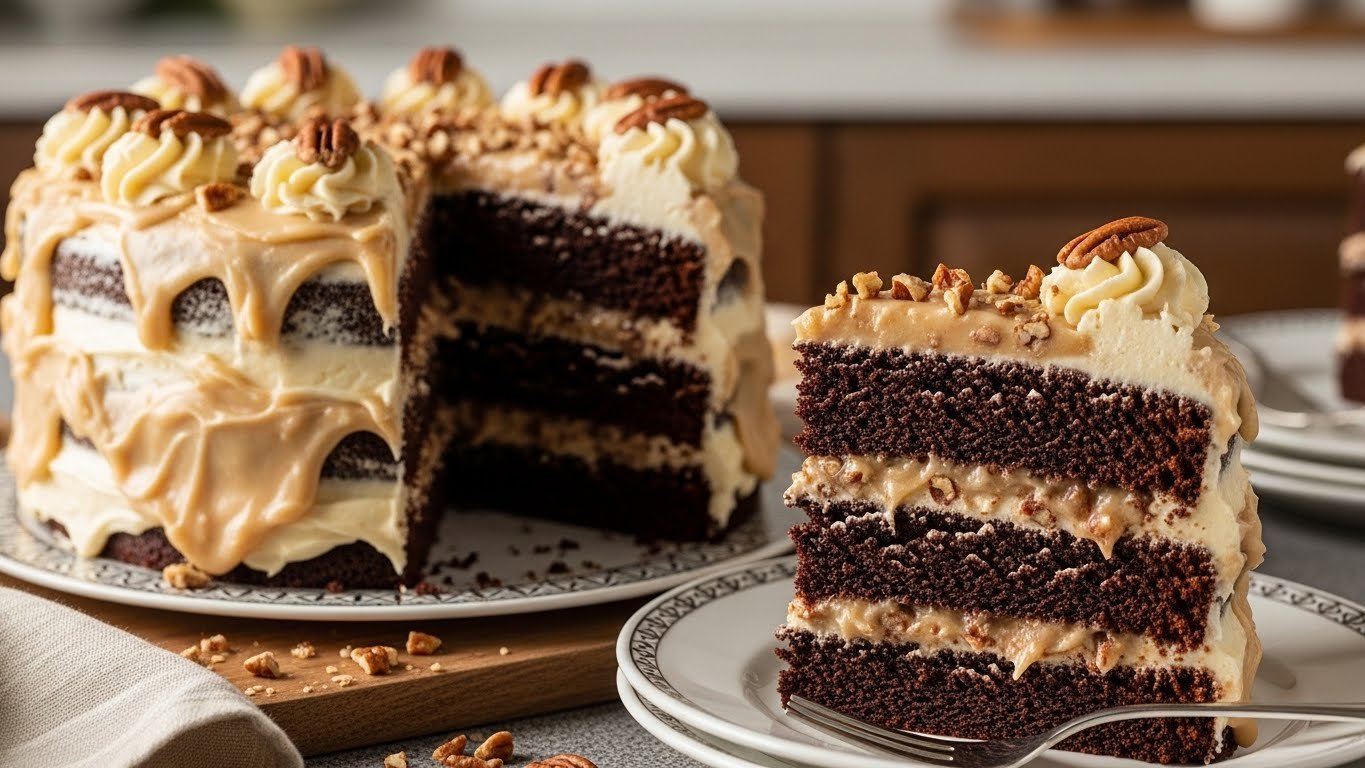
There are few desserts as impressive and delicious as a towering German chocolate cake with its signature coconut pecan frosting spilling down the sides. This isn’t your everyday chocolate cake, it’s something special with layers of tender, mildly sweet chocolate cake and that incredible caramel-coconut-pecan filling that makes this cake legendary. Every bite is a perfect balance of textures and flavors that just makes you close your eyes and savor the moment.
Today, I’m sharing my absolute best German chocolate cake recipe that delivers bakery-quality results in your own kitchen. This cake features moist, tender chocolate layers made with real German chocolate, and that famous coconut pecan frosting that’s gooey, nutty, and absolutely addictive. Don’t worry if you’ve never made a layer cake before or if frosting intimidates you. This recipe breaks everything down into simple, manageable steps that anyone can follow. Let me show you how to create this showstopping dessert that will have everyone asking for your recipe!
History / Background
Despite its name, German chocolate cake isn’t actually from Germany! This beloved American dessert has a fascinating origin story that starts in 1852 when an English-American chocolatier named Samuel German developed a type of dark baking chocolate for the Baker’s Chocolate Company. This chocolate was sweeter than regular baking chocolate, making it easier to use in desserts. The company named it “Baker’s German’s Sweet Chocolate” in his honor.
The cake itself didn’t appear until over a century later. In 1957, a homemaker from Dallas, Texas, named Mrs. George Clay sent her recipe for “German’s Chocolate Cake” to a local newspaper. The recipe used Baker’s German’s Sweet Chocolate and featured that distinctive coconut-pecan filling. The recipe was so popular that it was reprinted in newspapers across the country, and Baker’s Chocolate Company saw their sales of German’s Sweet Chocolate skyrocket by 73% in just one year!
The company quickly recognized the marketing opportunity and began printing Mrs. Clay’s recipe on the packaging of their chocolate bars. The recipe spread like wildfire through community cookbooks, church socials, and family gatherings throughout the late 1950s and 1960s. Soon, German chocolate cake became a staple of American celebrations, particularly in the South where it remains incredibly popular today.
Over the decades, the apostrophe and the “s” were dropped, and “German’s Chocolate Cake” became simply “German Chocolate Cake,” which led many people to incorrectly assume it originated in Germany. The cake represents the best of mid-century American baking: approachable ingredients transformed into something extraordinary through creative combination.
Today, German chocolate cake is considered a classic that bridges generations. It’s the kind of cake that shows up at milestone birthdays, anniversaries, and family reunions, carrying with it decades of sweet memories and traditions.
Why You’ll Love This Recipe
- Incredibly Moist Layers: The chocolate cake stays tender and moist for days thanks to the perfect balance of ingredients and technique.
- Not Too Sweet: Unlike some chocolate cakes, this one has a subtle sweetness that lets the coconut pecan frosting shine without being overwhelming.
- Unique Texture: The combination of soft cake with that chunky, chewy coconut-pecan topping creates an amazing textural experience in every bite.
- Impressive Presentation: The rustic, casual look of the frosting dripping between layers is naturally beautiful without requiring fancy decorating skills.
- Perfect Chocolate Flavor: German chocolate has a milder, sweeter chocolate taste that’s less intense than dark chocolate, making it universally appealing.
- Crowd-Pleaser: This cake appeals to everyone, from kids to grandparents. It’s a guaranteed hit at any gathering.
- Make-Ahead Friendly: Both the cake layers and frosting can be prepared in advance, making party prep manageable.
- Nostalgic Appeal: For many people, this cake brings back wonderful memories of celebrations and special occasions.
- Clear Instructions: Every step is explained thoroughly so even first-time cake bakers can succeed.
- Authentic Recipe: This version stays true to the classic while ensuring foolproof results every time.
- Feeds a Crowd: One cake serves 12 to 16 people generously, making it economical and practical for gatherings.
Ingredient Notes
For the Chocolate Cake:
German Sweet Chocolate: This is the traditional chocolate used in German chocolate cake. Baker’s German’s Sweet Chocolate is the classic choice, sold in 4-ounce bars in the baking aisle. If you can’t find it, you can substitute with semi-sweet chocolate, though the flavor will be slightly different.
All-Purpose Flour: The foundation of your cake. Always measure by spooning flour into your measuring cup and leveling it off with a knife. Scooping directly from the bag adds too much flour, making your cake dense and dry.
Baking Soda: This is your leavening agent that helps the cake rise and creates a tender crumb. Make sure it’s fresh! Old baking soda won’t work properly.
Salt: Enhances the chocolate flavor and balances sweetness. Don’t skip it even though it’s a small amount.
Unsalted Butter: Use real butter at room temperature for the best flavor. Room temperature means soft enough to leave an indentation when pressed, but still holding its shape. This typically takes 1 to 2 hours out of the refrigerator.
Granulated Sugar: Provides sweetness and helps create the cake’s structure. When creamed with butter, sugar creates air pockets that make the cake light.
Eggs: Large eggs at room temperature work best. Room temperature eggs incorporate more smoothly and create better volume. Set them out when you take out your butter.
Vanilla Extract: Use pure vanilla extract for the best flavor. It enhances the chocolate and adds depth to the overall taste.
Buttermilk: This is key to tender, moist cake! The acidity reacts with baking soda for extra lift, and the fat adds richness. If you don’t have buttermilk, make a substitute by adding 1 tablespoon of lemon juice or white vinegar to 1 cup of milk and letting it sit for 5 minutes.
For the Coconut Pecan Frosting:
Egg Yolks: These create the rich, custard-like base of the frosting. Use only the yolks, not whole eggs. They should be at room temperature for best results.
Evaporated Milk: Not sweetened condensed milk! Evaporated milk is unsweetened and has a thick, creamy consistency that’s perfect for this frosting. One 12-ounce can is exactly what you need.
Granulated Sugar: Sweetens the frosting and helps create that wonderful caramel-like flavor when cooked.
Unsalted Butter: Adds richness and helps the frosting thicken as it cools.
Vanilla Extract: Enhances all the other flavors and adds warmth to the frosting.
Sweetened Shredded Coconut: Look for the kind in bags, not fresh coconut. The sweetened variety is traditional and adds both flavor and texture.
Chopped Pecans: Toasted pecans add incredible nutty flavor and crunch. Always toast them first to bring out their oils and deepen the flavor!
Equipment Needed
Three 9-inch Round Cake Pans: For creating those beautiful layers. Make sure they’re at least 2 inches deep. Light-colored metal pans work best for even baking.
Parchment Paper: Cut circles to fit the bottom of each pan. This ensures your cakes release perfectly every time.
Stand Mixer or Hand Mixer: Makes mixing much easier, though you can mix by hand if needed. You’ll use it for the cake batter.
Large Mixing Bowls: You’ll need several for different components of the recipe.
Medium Saucepan: For cooking the coconut pecan frosting on the stovetop.
Wooden Spoon: For stirring the frosting as it cooks. A wooden spoon won’t conduct heat like metal.
Measuring Cups and Spoons: Accurate measurements are crucial for layer cakes. Have both dry and liquid measuring tools ready.
Rubber Spatula: Essential for scraping bowls and spreading frosting.
Wire Cooling Racks: You need space to cool all three layers. If you don’t have three racks, cool them in batches.
Double Boiler or Microwave-Safe Bowl: For melting the chocolate gently without burning it.
Whisk: For mixing ingredients and ensuring the frosting cooks smoothly.
Toothpicks or Cake Tester: For checking if the cake layers are done baking.
Offset Spatula (optional but helpful): Makes spreading frosting between layers easier, though a regular butter knife works too.
Cake Plate or Stand: Choose a pretty presentation plate for your finished cake.
Full Recipe Card
Decadent German Chocolate Cake
Prep Time: 30 minutes
Bake Time: 30 to 35 minutes
Frosting Time: 30 minutes
Cooling Time: 1 hour 30 minutes
Total Time: 3 hours
Yield: 12 to 16 servings
Difficulty: Moderate
Ingredients
For the Chocolate Cake:
- 4 ounces German sweet chocolate, chopped
- ½ cup (120ml) boiling water
- 2¼ cups (280g) all-purpose flour
- 1 teaspoon baking soda
- ½ teaspoon salt
- 1 cup (2 sticks/226g) unsalted butter, room temperature
- 2 cups (400g) granulated sugar
- 4 large eggs, separated, room temperature
- 1 teaspoon vanilla extract
- 1 cup (240ml) buttermilk, room temperature
For the Coconut Pecan Frosting:
- 4 large egg yolks
- 1 can (12 ounces/354ml) evaporated milk
- 1½ cups (300g) granulated sugar
- ¾ cup (1½ sticks/170g) unsalted butter
- 1½ teaspoons vanilla extract
- 2½ cups (200g) sweetened shredded coconut
- 1½ cups (170g) chopped pecans, toasted
Instructions
Step 1: Prepare Pans and Chocolate
Position your oven rack in the center and preheat to 350°F (175°C). Grease three 9-inch round cake pans thoroughly with butter or nonstick spray. Cut parchment circles to fit the bottoms and press them in. Grease the parchment too. Lightly dust with flour, tapping out excess. Meanwhile, place the chopped chocolate in a small bowl and pour the boiling water over it. Stir until completely melted and smooth. Set aside to cool.
Step 2: Mix Dry Ingredients
In a medium bowl, whisk together the flour, baking soda, and salt. Whisk for about 30 seconds to ensure everything is evenly distributed. Set this bowl aside.
Step 3: Toast the Pecans
Spread the chopped pecans on a baking sheet and toast in the preheating oven for 5 to 7 minutes, stirring once, until fragrant and lightly golden. Remove and let cool. This can be done while you make the cake.
Step 4: Cream Butter and Sugar
In your stand mixer bowl fitted with the paddle attachment (or using a hand mixer in a large bowl), beat the softened butter on medium speed for about 1 minute until smooth. Add the sugar and beat on medium-high speed for 4 to 5 minutes until very light, fluffy, and pale. This creaming process is crucial! Don’t rush it. Scrape down the sides of the bowl a couple of times.
Step 5: Add Egg Yolks
Turn mixer to medium speed. Add the egg yolks one at a time, beating well after each addition (about 30 seconds per yolk). Make sure each yolk is fully incorporated before adding the next. The mixture should look smooth and creamy.
Step 6: Add Chocolate and Vanilla
With the mixer on low speed, add the melted chocolate mixture and vanilla extract. Mix until fully combined and the batter is evenly colored. Scrape down the bowl.
Step 7: Alternate Dry and Wet Ingredients
With mixer on low speed, add about one-third of the flour mixture. Mix just until barely combined. Add half of the buttermilk and mix. Continue alternating, ending with flour. The pattern is: flour, buttermilk, flour, buttermilk, flour. After the final flour addition, mix only until you can’t see white streaks. Don’t overmix! The batter will be thick.
Step 8: Beat Egg Whites
In a separate clean bowl using clean beaters, beat the 4 egg whites on high speed until stiff peaks form. This takes about 3 to 4 minutes. The whites should stand straight up when you lift the beaters and look glossy.
Step 9: Fold in Egg Whites
Using a rubber spatula, gently fold the beaten egg whites into the chocolate batter in three additions. Use a gentle folding motion, cutting down through the center, across the bottom, and up the side. Rotate the bowl as you fold. This incorporates the whites without deflating them, keeping the cake light. Fold just until no white streaks remain.
Step 10: Bake the Layers
Divide the batter evenly among the three prepared pans. A kitchen scale helps, aim for about 600g per pan. Smooth the tops gently. Bake for 30 to 35 minutes until the cakes spring back when lightly touched and a toothpick inserted in the center comes out clean or with just a few moist crumbs. The cakes will pull away slightly from the pan sides.
Step 11: Cool the Cakes
Let cakes cool in their pans on wire racks for 15 minutes. Run a knife around the edges, then invert onto cooling racks. Carefully peel off the parchment paper. Let cool completely, at least 1 hour. The cakes must be completely cool before frosting!
Step 12: Make the Frosting
In a medium saucepan, whisk together the egg yolks, evaporated milk, sugar, and butter. Place over medium heat and cook, stirring constantly with a wooden spoon, for about 12 to 15 minutes. The mixture will thicken and turn golden brown. It should coat the back of your spoon. Don’t rush this process! If you cook it on high heat, the eggs might scramble.
Step 13: Finish the Frosting
Remove the saucepan from heat and stir in the vanilla, coconut, and toasted pecans. Let the frosting cool to room temperature, stirring occasionally. It will thicken considerably as it cools, about 30 to 45 minutes. If you’re impatient, you can refrigerate it for 15 to 20 minutes, stirring every 5 minutes, but don’t let it get too cold or it will be hard to spread.
Step 14: Assemble the Cake
Place your first cake layer on a serving plate, bottom-side up for the flattest surface. Spread about one-third of the frosting over the top, going all the way to the edges. It’s okay if some spills over, that’s part of the rustic charm! Place the second layer on top, again bottom-side up. Spread with another third of the frosting. Top with the final layer, this time placing it top-side up so the flat bottom creates a smooth surface on top.
Step 15: Final Frosting
Spread the remaining frosting over the top layer, letting it naturally drip down the sides if it wants to. You can spread a thin layer on the sides too, or leave them mostly bare for a traditional look. The beauty of German chocolate cake is that it doesn’t need to be perfectly smooth or decorated. The chunky frosting creates its own gorgeous presentation!
Step 16: Let It Set
Let the cake sit at room temperature for at least 30 minutes before slicing. This allows the frosting to set slightly, making cleaner cuts. If you cut too soon, the layers might slide.
Recipe Notes
- The beaten egg whites are what make this cake incredibly light and tender. Don’t skip this step or try to use whole eggs!
- The frosting must be cooked on medium heat while stirring constantly. High heat will scramble the eggs.
- Make sure the frosting is cooled to at least room temperature before spreading. If it’s too warm, it will be runny. If too cold, it will be stiff.
- This cake is best served at room temperature. The flavors and textures are most enjoyable when not cold.
- Store any leftovers covered in the refrigerator due to the egg-based frosting, but let slices come to room temperature before serving.
Tips & Variations
Chocolate Variation: For more intense chocolate flavor, use semi-sweet chocolate instead of German sweet chocolate. The cake will be slightly less sweet and more deeply chocolate-flavored.
Extra Coconut: If you’re a coconut lover, increase the coconut in the frosting to 3 cups. You can also toast the coconut before adding it for a nutty, caramelized flavor.
Walnut Substitution: Pecans are traditional, but walnuts work beautifully too. Toast them the same way as pecans for the best flavor.
Bourbon Addition: Add 2 tablespoons of bourbon to the frosting for a sophisticated, adult version. The bourbon enhances the caramel notes beautifully.
Two-Layer Version: Make just two layers for a shorter cake that’s easier to manage. Divide the batter between two pans and bake for 35 to 40 minutes.
Chocolate Ganache Sides: For a fancier presentation, frost the sides with chocolate ganache and reserve the coconut pecan frosting for between layers and on top.
Cupcake Version: This batter makes about 30 cupcakes. Bake at 350°F for 18 to 22 minutes. Top each with a generous spoonful of frosting.
Sheet Cake: Pour batter into a greased 9×13-inch pan and bake for 40 to 45 minutes. Spread all the frosting on top for an easier, more casual presentation.
Pro Chef Tips
Room Temperature Matters: Eggs, butter, and buttermilk should all be at cool room temperature (about 65 to 70°F). Cold ingredients don’t mix smoothly and can cause the batter to curdle or separate.
Chocolate Cooling: Let the melted chocolate mixture cool to lukewarm before adding to the batter. If it’s too hot, it can cook the eggs or melt the butter too much, affecting texture.
Stiff Peak Egg Whites: When beating egg whites, they should form peaks that stand straight up without drooping. Under-beaten whites won’t provide enough lift. Over-beaten whites become dry and don’t fold in smoothly.
Gentle Folding: When incorporating egg whites, use a light hand. Over-folding deflates them and makes your cake dense. It’s okay if there are a few tiny white streaks remaining.
The Spoon Test: The frosting is ready when it coats the back of a spoon and doesn’t run off immediately. If you draw your finger through the coating, it should leave a clear line.
Constant Stirring: When cooking the frosting, never stop stirring! If you walk away, the eggs can scramble or the bottom can burn. Keep that spoon moving in a figure-eight pattern.
Frosting Consistency: The frosting should be spreadable but thick with chunks of coconut and pecans. If it’s too thin, let it cool longer. If too thick, you can thin it with a tablespoon of evaporated milk.
Toast for Flavor: Toasting the pecans is a small step that makes a huge difference. Raw pecans taste flat compared to toasted ones, which are rich, nutty, and aromatic.
Common Mistakes to Avoid
Not Separating Eggs Properly: Getting even a tiny bit of yolk in your whites will prevent them from whipping properly. Separate carefully, and if any yolk gets in, start with a fresh bowl and whites.
Skipping the Egg White Step: Some people try to use whole eggs to save time, but this makes the cake dense and heavy. The whipped whites are essential for the classic texture.
Overmixing After Adding Flour: Once flour is added, mix only until combined. Overmixing develops gluten, creating a tough cake. Stop mixing as soon as you don’t see white streaks.
Cooking Frosting on High Heat: High heat scrambles the eggs and can burn the mixture. Medium heat with constant stirring is the only way to achieve smooth, thick frosting.
Spreading Warm Frosting: If the frosting is too warm, it will be runny and slide right off the cake. If it’s too cold, it will be stiff and tear the cake. Room temperature is perfect!
Not Toasting the Pecans: This small step makes the nuts taste so much better. Raw pecans are soft and bland. Toasted pecans are crunchy and flavorful.
Frosting Warm Cake: Never frost warm cake! The heat will melt the frosting and create a goopy mess. Always wait until the layers are completely cool.
Not Stirring Frosting Constantly: If you stop stirring while the frosting cooks, you risk scrambling the eggs or burning the bottom. Keep that spoon moving!
Opening Oven Too Soon: Don’t open the oven door for at least the first 25 minutes. Each time you open it, the temperature drops dramatically, which can cause cakes to sink.
Using Sweetened Condensed Milk: This is a completely different product from evaporated milk! Sweetened condensed milk is thick, sweet, and will make your frosting way too sweet and thick.
Storage & Meal Prep
Room Temperature Storage: Because this cake has a cooked egg-based frosting, it’s best to eat what you’ll consume within a few hours and refrigerate the rest. If your kitchen is cool (below 70°F), it can sit out for up to 4 hours.
Refrigerator Storage: Store leftover cake covered in the refrigerator for up to 5 days. The frosting contains eggs and dairy, so refrigeration is necessary for food safety. Cover with a cake dome or tent loosely with plastic wrap.
Bringing to Room Temperature: For the best flavor and texture, remove slices from the refrigerator 30 minutes before serving. The cake tastes much better at room temperature than cold! The chocolate flavor blooms and the texture softens.
Slicing Tips: Use a sharp knife dipped in hot water and wiped dry between cuts. This creates clean slices through all those layers without dragging the frosting.
Individual Slices: Wrap individual slices in plastic wrap and store in airtight containers. This makes grabbing a slice easy and prevents the whole cake from being exposed to air repeatedly.
Make-Ahead & Freezer Notes
Baking Layers Ahead: Bake the cake layers up to 2 days in advance. Once completely cool, wrap each layer tightly in plastic wrap, then aluminum foil. Store at room temperature or in the refrigerator. This actually makes assembly easier since the layers are firm!
Freezing Cake Layers: Wrapped layers freeze beautifully for up to 3 months. Thaw overnight in the refrigerator still wrapped, or at room temperature for 2 to 3 hours. Frozen layers are even easier to frost because they’re very firm and won’t tear.
Frosting Ahead: The coconut pecan frosting can be made 1 to 2 days ahead and refrigerated in an airtight container. Bring it to room temperature and stir well before using. If it seems too thick, you can gently warm it or stir in a tablespoon of evaporated milk.
Freezing Frosted Cake: You can freeze the entire assembled cake! Freeze it uncovered for 1 hour until the frosting is firm, then wrap tightly in plastic wrap and foil. Freeze for up to 2 months. Thaw overnight in the refrigerator, still wrapped, then bring to room temperature before serving.
Assembly Timeline: For stress-free entertaining, bake layers 1 to 2 days ahead, make frosting 1 day ahead, and assemble the morning of your event. This spreads out the work and actually makes the cake taste better as flavors meld.
Freezing Slices: Wrap individual slices tightly and freeze for up to 3 months. Thaw at room temperature for about 1 hour. This is perfect for having a slice whenever the craving hits!
Serving Suggestions
Classic Presentation: Serve generous slices on pretty dessert plates with a fork. The rustic beauty of this cake needs no additional garnish, though a few extra pecans on top of each slice look nice.
With Whipped Cream: A dollop of lightly sweetened whipped cream on the side balances the richness and adds a creamy element. Some people love this pairing!
Coffee Pairing: This cake is heavenly with a cup of strong coffee or espresso. The coffee cuts through the richness and enhances the chocolate flavor.
Ice Cream Addition: Serve with vanilla ice cream or butter pecan ice cream on the side. The cold creaminess contrasts beautifully with the cake’s texture.
Holiday Centerpiece: This cake is popular at Thanksgiving and Christmas. The coconut pecan topping feels festive and special, making it perfect for holiday gatherings.
Birthday Tradition: Many families make this their traditional birthday cake. Add candles on top and it’s instantly celebratory!
Potluck Star: This cake transports well and serves a crowd, making it ideal for potlucks and covered dish dinners. It always disappears quickly!
With Hot Fudge: For the ultimate indulgence, warm a slice slightly and drizzle with hot fudge sauce. This takes it completely over the top in the best way!
Afternoon Treat: A thin slice with afternoon tea or coffee is a wonderful pick-me-up. The cake isn’t too heavy for an afternoon treat.
Special Occasions: This is the cake for milestone birthdays, anniversaries, retirements, and celebrations. It says “this is a special occasion” without words.
FAQs
Can I make this without separating the eggs?
While you technically can use whole eggs, you won’t get the same light, tender texture. The beaten egg whites are what make this cake special and different from regular chocolate cake. I strongly recommend following the recipe as written for authentic results.
What if I can’t find German sweet chocolate?
You can substitute with semi-sweet chocolate, though the flavor will be less sweet and more intensely chocolate. Or try this: combine 1 tablespoon sugar with 3 tablespoons unsweetened cocoa powder and 1 tablespoon melted butter for each ounce of German chocolate needed.
Why did my frosting turn out grainy?
This usually means it was cooked at too high heat, causing the eggs to scramble slightly, or it wasn’t stirred constantly. The frosting should be smooth and custard-like. Make sure to cook over medium heat while stirring continuously.
Can I use egg substitute instead of fresh eggs?
For the cake, you need real eggs that can be separated and whipped. Egg substitutes won’t work. For the frosting, you might be able to use a pasteurized egg product, but I haven’t tested this.
My layers came out with a dome. How do I prevent this?
Some doming is normal. You can level them with a serrated knife. To minimize doming, try using cake strips (wet fabric strips) wrapped around the pans, or lower the oven temperature to 325°F and bake slightly longer.
How do I know when the frosting is thick enough?
The frosting should coat the back of a spoon thickly. When you draw your finger through the coating, it should leave a clear path. It will thicken more as it cools, so don’t overcook it.
Can I make this as cupcakes?
Absolutely! Fill cupcake liners about two-thirds full and bake at 350°F for 18 to 22 minutes. Top each cupcake with a generous spoonful of the coconut pecan frosting. You’ll get about 30 cupcakes.
Is there a way to make this dairy-free?
This would be difficult as butter and evaporated milk are key ingredients. You might be able to use dairy-free alternatives, but I haven’t tested this, and the texture would likely be different.
Why is my cake dense instead of light?
Most likely the egg whites weren’t beaten to stiff peaks, or they were deflated during folding. Also check that you didn’t overmix the batter after adding flour. Proper technique with the egg whites is crucial for light texture.
Conclusion
Congratulations! You now have everything you need to make an absolutely spectacular German chocolate cake that will blow away anyone who tries it. This isn’t just a dessert, it’s an experience with its tender chocolate layers and that incredible coconut pecan frosting that makes this cake legendary. Every element works together to create something truly special that’s worth every minute of effort.
The beautiful thing about this recipe is that while it has several steps, none of them are particularly difficult. You’re just mixing a cake batter (with the added step of whipping egg whites), cooking a stovetop frosting, and stacking it all together. Broken down like that, it’s totally manageable, even if you’re relatively new to baking. And the results look and taste so impressive that people will think you’re a professional baker!
Don’t be intimidated by the egg white whipping or the stovetop frosting. These techniques are actually quite forgiving once you understand what you’re looking for. The egg whites should stand up in stiff peaks, and the frosting should thicken enough to coat a spoon. Follow the visual cues in the recipe, and you’ll know when each step is complete. Trust yourself and the process!
Remember that even if your first attempt isn’t picture-perfect, it will still taste absolutely amazing. German chocolate cake is meant to be rustic and homey, not fussy or overly decorated. That’s part of its charm! The coconut pecan frosting naturally creates a beautiful, textured look that’s appealing in its unpretentious way.
This cake is about creating memories and traditions. Maybe it becomes your signature birthday cake, or the dessert you make for special celebrations, or simply a weekend baking project that brings joy to your kitchen. Whatever the occasion, you’re creating something from scratch that brings people together and makes them smile.
So gather your ingredients, clear your counter space, and get ready to make something truly spectacular. Your kitchen is about to smell like chocolate heaven, and your cake stand is about to hold something that everyone will remember. Happy baking, and may your layers be tender, your frosting be perfectly thick, and your cake be absolutely delicious!