Introduction
If you’re looking for an easy, beautiful, and truly customizable sweet treat, homemade chocolate bark is a perfect choice.
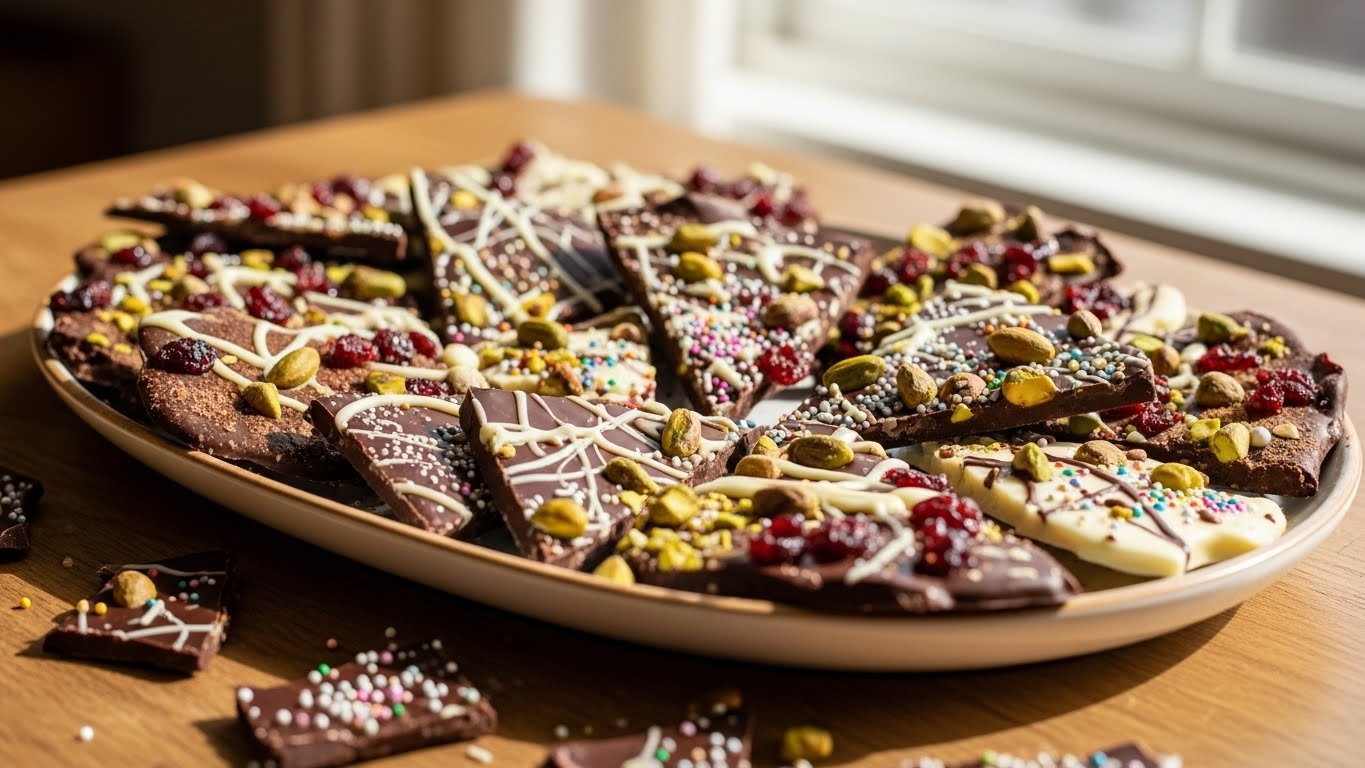
Chocolate bark is simply melted chocolate spread into a thin layer and topped with anything you like: nuts, dried fruit, pretzels, candies, cookies, seeds, coconut, and more. Once it sets, you break it into rustic pieces and enjoy. That’s it. No special baking skills needed. No fancy equipment.
It’s one of my favorite recipes for:
- Last-minute gifts
- Holiday treat plates
- Snack trays for parties
- A fun kitchen project with kids
- Using up little bits of nuts, dried fruit, or candy from the pantry
This version is a customizable chocolate bark – you choose your chocolate, choose your toppings, and decorate it however you like. I’ll walk you through the basics, give you lots of ideas, and share tips to make your bark shiny, snappy, and delicious.
If you can melt chocolate and sprinkle toppings, you can make this recipe. Let’s get started.
History / Background
Chocolate bark doesn’t have a long, complicated history like some classic desserts. It’s more of a modern, home-baker favorite that grew popular for a few simple reasons:
- It’s incredibly easy.
- It looks impressive.
- It’s very flexible and forgiving.
The name “bark” comes from its appearance. When you spread chocolate in a sheet and break it into pieces, the jagged edges and rough shapes can look a little bit like tree bark.
Over time, chocolate bark became especially popular around the holidays. People started making:
- Peppermint bark at Christmas (dark and white chocolate with crushed candy canes)
- Fruit and nut bark as a slightly more grown-up treat
- Colorful candy-topped bark for kids’ parties
These days, chocolate bark is made in many variations all over the world. It’s often sold in chocolate shops and coffee shops, but it’s just as easy (and much more affordable) to make at home.
This recipe gives you a base method that works for any flavor combination, so you can create your own favorite bark, whether it’s sweet and salty, fruity and nutty, or simple and elegant.
Why You’ll Love This Recipe
• Super easy, no baking required – Just melt, spread, top, and chill.
• Endlessly customizable – Use your favorite chocolate and toppings; great for creativity.
• Perfect homemade gift – Wrap pieces in pretty bags or boxes, and you have a thoughtful, handmade present.
• Beginner-friendly – No special skills or tools needed; clear step-by-step instructions.
• Uses simple ingredients – Chocolate plus whatever toppings you have at home.
• Scales easily – Make a small batch for yourself or a big batch for parties and gifts.
• Fun for kids – Children can help choose toppings and sprinkle them on.
• Great for special diets – Easily make dairy-free, vegan, gluten-free, or nut-free versions with the right ingredients.
• Looks beautiful – Colorful toppings make it look fancy, even though it’s simple to make.
• Great make-ahead dessert – Keeps well and can be made days in advance.
Ingredient Notes
The beauty of chocolate bark is that you only need two main things:
- Chocolate
- Toppings
Let’s talk about each in more detail.
Chocolate
Chocolate is the base, so choose one you enjoy eating by itself.
Good options:
- Dark chocolate (bittersweet or semisweet, around 60–70% cocoa)
- Milk chocolate (sweeter and creamier)
- White chocolate (sweet and mild, great with fruity or tart toppings)
You can also mix types:
- Swirl dark and white chocolate
- Use half dark and half milk chocolate
Try to use good quality chocolate:
- Chocolate bars or couverture chocolate are ideal.
- Chocolate chips work in a pinch, but they sometimes contain stabilizers that make them a bit thicker when melted.
If you want a shiny bark that “snaps” when you break it, you can temper the chocolate. For beginners, we’ll use an easy microwave method that gives a nice result without complicated tools. I’ll explain it in the recipe and tips.
Toppings
This is where you can get creative. Some ideas:
Nuts:
- Almonds (sliced, slivered, or whole chopped)
- Pistachios (great color)
- Pecans or walnuts (especially good toasted)
- Hazelnuts (chopped or whole)
Dried Fruit:
- Cranberries
- Raisins or sultanas
- Chopped apricots
- Dried cherries
- Dried mango or pineapple (for a tropical twist)
Crunchy & Salty:
- Crushed pretzels
- Crushed cookies (Oreos, shortbread, graham crackers)
- Popcorn
- Salted peanuts
Sweet Extras:
- Mini marshmallows
- Toffee bits or caramel pieces
- Candy-coated chocolates (M&M’s, for example)
- Crushed candy canes or peppermint candies
- Sprinkles
Seeds & Other:
- Pumpkin seeds (pepitas)
- Sunflower seeds
- Shredded or toasted coconut
- A light sprinkle of flaky sea salt on top for a gourmet touch
Try to combine different textures and flavors:
- Something crunchy (nuts, pretzels, cookies)
- Something sweet or chewy (dried fruit, marshmallows)
- Maybe something salty (salted nuts, pretzels, sea salt)
Flavorings (Optional)
You can also add:
- A little vanilla extract
- A hint of almond extract
- Orange zest or lemon zest
- Instant espresso powder (for mocha bark)
- Ground cinnamon or other warm spices (for a holiday twist)
Add just a small amount so the flavors don’t overpower the chocolate.
Equipment Needed
You don’t need any special tools for chocolate bark. Just a few basic kitchen items.
Essential Equipment
- Baking sheet (rimmed tray)
- Parchment paper or baking paper (or a silicone baking mat)
- Microwave-safe bowl (or a heatproof bowl for a double boiler)
- Spatula or spoon (for stirring and spreading)
- Knife (for chopping chocolate and toppings)
Helpful Extras
- Small offset spatula (for smoother spreading)
- Measuring cups (if you like to measure toppings more exactly)
- Rubber scraper (to get every bit of melted chocolate out of the bowl)
That’s really all you need.
Full Recipe Card (ingredients, instructions, notes)
Customizable Chocolate Bark – Easy Homemade Gift or Sweet Treat
Yield: About 1 large sheet of bark (serves 8–12, depending on piece size)
Prep Time: 20 minutes
Chill Time: 20–30 minutes
Total Time: 40–50 minutes
Difficulty: Easy
Ingredients
- 12 oz (340 g) good quality chocolate (dark, milk, white, or a mix)
- ½–1 cup mixed toppings of your choice (nuts, dried fruit, pretzels, cookies, etc.), roughly chopped if needed
- Optional: ¼–½ teaspoon flavoring (vanilla, orange zest, etc.)
- Optional: Pinch of flaky sea salt for sprinkling on top
Instructions
- Prepare your pan
- Line a baking sheet with parchment paper or a silicone baking mat.
- Set aside on a flat surface where it can rest undisturbed while the chocolate sets.
- Prepare your toppings
- Chop any large nuts, dried fruit, or cookies into small bite-sized pieces.
- Gather all your toppings into small bowls so they are ready to sprinkle quickly once you spread the chocolate.
- Chop the chocolate
- Roughly chop your chocolate into small, even pieces. This helps it melt smoothly and evenly.
- Melt the chocolate (easy microwave method)
- Place about two-thirds of the chopped chocolate (around 8 oz / 225 g) into a microwave-safe bowl.
- Microwave in 20–30 second bursts, stirring well after each burst, until most of the chocolate is melted but some small pieces remain.
- Add the remaining one-third of the chocolate to the bowl and stir until completely melted and smooth.
- If the chocolate doesn’t fully melt, you can microwave for a few more seconds, but avoid overheating.
- If you are using any liquid flavorings (like vanilla extract), stir them in now.
- Spread the chocolate
- Pour the melted chocolate onto your prepared baking sheet.
- Use a spatula or spoon to spread it into an even layer, about ¼ inch (0.5–0.6 cm) thick.
- You can make it into a rectangle or just an organic, free-form shape.
- Don’t spread it too thin or it may break very easily; too thick, and it will be hard to bite.
- Add toppings
- While the chocolate is still soft and glossy, quickly sprinkle your toppings evenly over the surface.
- Gently press larger pieces (like big nuts or pretzel chunks) into the chocolate so they stick.
- If you are using flaky sea salt, lightly sprinkle it on top now.
- Set the bark
- Let the chocolate bark sit at room temperature until completely set and firm (this can take 1–2 hours, depending on the room temperature).
- If your kitchen is warm or you’re in a hurry, place the tray in the refrigerator for 20–30 minutes until set.
- Avoid leaving it in the fridge for too long if using tempered chocolate, as quick temperature changes can sometimes cause a bit of dullness or light streaks.
- Break into pieces
- Once the chocolate is fully set, peel the bark off the parchment paper.
- Use your hands to break it into rustic pieces, or use a sharp knife to cut it into neat squares or rectangles.
- Serve or package
- Enjoy right away or package in bags, boxes, or tins for gifts.
- Store leftovers in an airtight container.
Recipe Notes
- If using very soft toppings (like marshmallows), add them sparingly so the bark keeps a good texture.
- For a swirled effect using two chocolates (e.g., dark and white), melt them separately, spread one as the base, and drizzle or dollop the second on top, then swirl with a toothpick or knife before adding toppings.
- This recipe is easy to double or halve. Just keep the same chocolate-to-topping ratio.
Tips & Variations
Chocolate bark is one of the most fun recipes to customize. Here are some ideas to inspire you.
Flavor Combinations
- Fruit and Nut Bark: Dark chocolate + almonds + dried cranberries + dried apricots + a pinch of sea salt.
- Peppermint Bark: Dark chocolate layer + white chocolate layer + crushed candy canes.
- Trail Mix Bark: Milk chocolate + peanuts + raisins + sunflower seeds + pretzel bits.
- Tropical Bark: White chocolate + toasted coconut + dried mango + dried pineapple + macadamia nuts.
- S’mores Bark: Milk or dark chocolate + mini marshmallows + crushed graham crackers + small chocolate chips.
- Mocha Bark: Dark chocolate + a pinch of instant espresso powder + chocolate-covered coffee beans (chopped) + a light sprinkle of sea salt.
- Cookie Crunch Bark: Milk or dark chocolate + crushed Oreos or other cookies + mini chocolate chips.
Colorful and Fun Bark
- Birthday Bark: White chocolate + colorful sprinkles + mini marshmallows + edible glitter.
- Holiday Bark:
- Christmas: Dark or white chocolate + red and green sprinkles + crushed peppermint.
- Easter: White chocolate + pastel-colored candy-coated chocolates.
- Halloween: Dark chocolate + orange and black sprinkles + candy eyes.
Healthier Options
- Use high-cocoa dark chocolate (70% or more).
- Top with nuts, seeds, and unsweetened dried fruit.
- Add just a tiny pinch of sea salt instead of extra sweet toppings.
Different Shapes
- Spread the chocolate in a thin rectangle and cut into bars rather than random shards.
- Use a silicone mold to make small bark squares or shapes.
- drizzle chocolate over parchment in different shapes and top them individually.
Pro Chef Tips
Here are some helpful tricks from a “pro” perspective to get beautiful, high-quality chocolate bark.
- Use dry, clean tools
Any water in your bowl or on your spoon can cause melted chocolate to seize (turn thick and grainy). Make sure everything is completely dry. - Chop chocolate evenly
Smaller, similar-sized pieces melt more evenly and reduce the risk of overheating. - Melt slowly and gently
Whether in the microwave or over a double boiler, take your time. Overheated chocolate can burn or become grainy. - Use the seeding method for better shine
Melting two-thirds of the chocolate, then stirring in the remaining one-third, helps give the bark a nicer finish without complicated tempering. - Don’t spread too thin
¼ inch thickness is a good target. Thinner bark is easier to snap but can also break too easily in bags or tins. - Press toppings lightly
After sprinkling toppings, press them very gently into the chocolate so they stick but don’t sink. - Let it set at room temperature when possible
This helps avoid condensation or streaking. Use the fridge only if your room is warm or you’re short on time. - Use contrasting colors and shapes
Mix bright fruits, green pistachios, white coconut, dark nuts, and sprinkles to make your bark visually attractive.
Common Mistakes to Avoid
Even though chocolate bark is easy, a few things can go wrong. Here’s how to avoid them.
1. Chocolate Seizing (Becoming Thick and Grainy)
Why it happens:
- Water or steam got into the chocolate
- Chocolate overheated in the microwave or double boiler
- Liquid colorings or extracts with water added directly
How to avoid:
- Make sure all tools are completely dry.
- Melt in short bursts, stirring often.
- Use oil-based colorings for candy melts, and alcohol-based or oil-based extracts (or add very small amounts after melting).
2. Toppings Falling Off
Why it happens:
- Adding toppings when the chocolate is already starting to set
- Not pressing toppings down gently
How to avoid:
- Have toppings ready before melting.
- Sprinkle toppings quickly while the chocolate is still glossy.
- Lightly press larger pieces into the chocolate.
3. Bark Too Hard or Too Thick
Why it happens:
- Spreading the chocolate in a very thick layer
How to avoid:
- Aim for about ¼ inch thickness.
- Use a larger baking sheet if needed to spread the chocolate more.
4. Dull or Streaky Chocolate
Why it happens:
- Chocolate not tempered or cooled correctly
- Sudden temperature changes (fridge then warm kitchen)
- Using low-quality chocolate or candy
How to avoid:
- Use good quality chocolate when possible.
- Use the seeding method and melt gently.
- Let bark set at room temperature when you can.
Note: A little dullness or streaking is OK for home treats and gifts. It still tastes great!
5. Bark Melting Too Easily at Room Temperature
Why it happens:
- Using chocolate chips or low-cocoa chocolate
- Very warm room or climate
How to avoid:
- Use higher cocoa content chocolate if your house is warm.
- Store in a cool, dry place and avoid direct sunlight.
- Use candy melts, which are designed to stay firm at room temperature.
Storage & Meal Prep
One of the best things about chocolate bark is how well it keeps.
How to Store Chocolate Bark
- Once the bark is completely set and broken into pieces, store it in an airtight container.
- Keep it in a cool, dry place, away from direct sunlight and heat.
- In normal room temperatures (around 65–70°F / 18–21°C), it should stay fresh for 2–3 weeks.
If your home is very warm:
- You can store chocolate bark in the refrigerator, but keep it in a sealed container to protect it from moisture and fridge smells.
Meal Prep Tips
- Chocolate bark is perfect for making ahead of time for parties or busy holidays.
- You can make it several days (even a couple of weeks) in advance and store it in a cool place.
- When ready to serve or package, just take it out, arrange on plates, or wrap in bags or boxes.
Make-Ahead & Freezer Notes
Make-Ahead
- Make a big batch of bark on a quiet day.
- Break it into pieces and store in an airtight container.
- It will be ready for:
- Last-minute guests
- Quick dessert platters
- Emergency gifts
Freezing
You can freeze chocolate bark, but there are a few things to know:
- Wrap the bark tightly in plastic wrap or foil.
- Place it in a freezer-safe container or zip-top bag.
- Freeze for up to 2–3 months.
To thaw:
- Move the container from the freezer to the fridge and let it thaw slowly.
- Then let it come to room temperature while still wrapped to avoid condensation forming on the chocolate.
Tip: If you can, it’s usually better just to store bark at room temperature in a cool place rather than freezing, to maintain the best texture and appearance.
Serving Suggestions
There are so many ways to enjoy and serve chocolate bark.
Simple Serving Ideas
- Arrange pieces on a pretty plate or wooden board.
- Mix different kinds of bark on one tray (e.g., fruit and nut bark, peppermint bark, and cookie bark).
- Serve with coffee, tea, or hot chocolate for a cozy treat.
For Gifts
- Place bark pieces in small treat bags and tie with ribbon.
- Arrange in gift boxes or tins with tissue paper.
- Add a handwritten label with the flavor (e.g., “Dark Chocolate Cranberry Almond Bark”).
For Parties
- Use chocolate bark on dessert tables or snack boards.
- Break into smaller pieces and add to:
- Ice cream bowls
- Yogurt parfaits
- Dessert charcuterie boards
- Pair with fresh fruit, nuts, and other small sweets.
FAQs
Q: Can I use chocolate chips for this recipe?
A: Yes, you can use chocolate chips. They may be a bit thicker when melted because they’re made to hold their shape in baking. If needed, add a tiny bit of oil to thin them. Good quality baking chips usually work best.
Q: How thick should I spread the chocolate?
A: About ¼ inch (0.5–0.6 cm) is a good thickness. Thinner bark is easier to bite, but very thin chocolate can break too easily.
Q: Do I have to temper the chocolate?
A: No, not for home treats. The simple microwave seeding method gives a nice result without complicated tempering. If you want a super glossy, professional finish, you can temper the chocolate more precisely, but it’s not required.
Q: Can I make this dairy-free or vegan?
A: Yes. Use dairy-free or vegan chocolate, and choose toppings that are also dairy-free (no milk chocolate candies, for example). Many dark chocolates are naturally dairy-free, but always check labels.
Q: Why did my chocolate turn grainy?
A: Most likely water got into it, or it overheated. Try melting more slowly next time and keep everything dry.
Q: Can I add liquid flavorings like orange extract?
A: Yes, but add only a small amount and stir well. Alcohol-based extracts are better than water-based, as water can cause chocolate to seize.
Q: How far in advance can I make chocolate bark for gifts?
A: If stored properly in a cool, dry place, you can make it 1–2 weeks ahead of time and it will still taste fresh.
Conclusion (friendly and encouraging)
You’ve just learned how to make customizable chocolate bark, one of the easiest and most beautiful homemade sweet treats or gifts you can create in your own kitchen.
All you really need is:
- Chocolate you enjoy
- Toppings you love
- A bit of time to melt, spread, and sprinkle
There’s no stress about perfect shapes or decorations. The charm of chocolate bark is in its rustic, broken pieces and all the color and texture on top. It’s artful and homemade at the same time.
If this is your first time working with melted chocolate, don’t worry. Even if your bark isn’t perfectly glossy or your pieces are all different sizes, it will still taste wonderful. Every batch you make will teach you a little more about how your microwave and chocolate behave, and you’ll quickly find your favorite flavor combinations.
So open your pantry, gather your bits of nuts, dried fruit, cookies, and candy, and have some fun. Make a small tray just for you, or a big batch to share and gift.